We are a Deanic (worshipping God as Mother, Divine Feminine) Ekklesia (assembly of like-minded believers) who worship and pray to our Mother God.
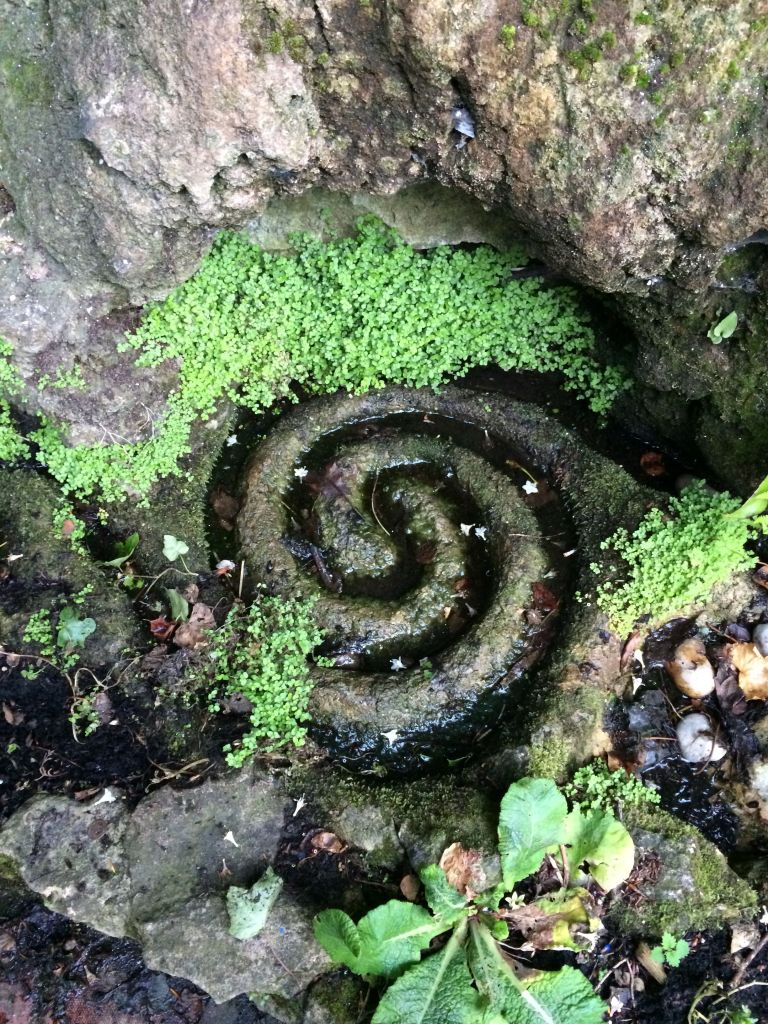
The Spiral Petroglyph, the oldest religious symbol of humanity. These meticulously carved or painted spirals are found globally, dating between 20,000 and 5000 BCE, are considered to be the earliest drawn sign of the Divine Feminine, the “Mother Goddess” of antiquity.
What do we believe?
In short?
We believe in our Mother God. The Great Goddess. She of countless names; the Creatrix and Mother of all things.
We believe that God is our Mother! We love Her and She loves us, personally and completely. She is eternal; the oldest faiths of this beautiful planet reached up to Her as we all reach to our mothers, and every religion in the world has its roots in Her worship.
We believe in the primordial Trinity; a Solar, Celestial Mother, who bears Her beloved Lunar Daughter, and a Third beyond even these Two, who is the Absolute. The Dark beyond the Light, and the Light beyond the Darkness.
We believe that devotion to Her is good and wholesome to our souls. That by turning our faces and hearts to Her, we are better prepared to face down the shadows and pitfalls of modern, ultra-secular culture.
We believe in an intelligent universe- one shaped by Her awesome and constant dance of joy. Thus, our faith is celebratory! We celebrate ‘feasting’ festival holidays, great and holy holidays, births, remembrances of life, and as many other reasons to find joy and celebration in Her beautiful creation as we can.
We believe our Mother God is a merciful Mother- one who sent Her Holy Daughter to descend beyond all darkness and bring Her own light to truly every corner of creation. And believe in the most holy mystery that exists beyond even these Two; Dea as Absolute Deity. She Who breathes out the universe, and will one day breathe it in again, in accordance with Her own eternal and holy will.
We believe the shadow put over our souls by evil is alleviated by the spark of the Daughter gifted eternally to each of us, our holy and endless Wisdom, and that our souls are given eternal ‘chances’ at life to learn, grow, and come closer to reunion with Her through the path of that holy spark of Wisdom.
We believe all things will be redeemed, for She has triumphed over death completely. Nothing is beyond a Mother’s sight, nor are Her hands too full to extend to one who needs Her. Though we may become mired in the weight and exhuastion of the material world, She is endlessly eager and excited to ‘fly to our sides’, and to bolster our spirits in every life we live.
We believe She comes to us through all time, through the lenses of countless faiths and cultures, so that each of us may understand at least a fragment of Her truth and grow ever closer to Her. Every faith of the world, through all of history and human belief, has its roots in Her worship.
We believe in Her servants within the spiritual world, the Janati. This is a uniquely Deanic term which has a root in the sanskrit ‘Jana’ meaning ‘Gate’ or ‘Portal’. These beings, Great and small, eternally act as Her hands and streams of power, and guard over all creation.
We believe there are seven of these great beings who are above even all others, the Seven Great Janati. They are the Living Streams of color, light, movement, and joy that eternally shine forth from the Mother, personal and knowable by those who turn their hearts to them.
We believe, in Her infinite mercy, that She has also set Janati to guard and guide each of us as we explore the path of our lives, and that this relationship is personal and communicative.
We believe all will become one with Her again, someday in the beautiful forever, and that until then, we can strive to keep our eyes turned to Her and our hearts open to Her.
And so with all that said…
Welcome home!
Glossary of terms on this page
Janite- of or related to the Janati, also, the name of our branch of Deanism
Janati, singular, Jana- comes from a combined root meaning ‘born’ or ‘portal’. See ‘Jataka’, the birth-stories (of the Buddhas) and in Latin languages, such words as ‘generation’ and ‘genesis’. Also the Sanskrit ‘Jana”, meaning ‘portal’, and ‘Genius’ meaning originally a guardian spirit.
Some versions of Deanic texts actually Latinize Janati as ‘Geniae’. The term ‘Jana’ ultimately means a spirit born or generated directly from Dea, and thus a secondary emanation of Deity – a spiritual ‘stream’ that has its Source in Her. It is sometimes rendered as either ‘angel’ or ‘goddess’, but both can easily be misunderstood, so Jana is preferred.
Deanism– The worship of God as the Divine Feminine, our Mother God. She is Supernal and Supreme.
Dea– Latin, feminine, ‘God’.
Kore Di-Jana
Who we are
The Janites are a Divine Feminine faith, and consist of validly ordained priestesses and an Ekklesia of devotees who worship Dea, our Divine Mother God.
Dea is God in “Her own right”, a being complete within Herself and Who, as Absolute Divinity, is supreme. The soul of the universe is Dea, the heart of all living things is Creation, and the soul within each of us is a daughter of Dea and a fragment of Her divinity.
Some of those in the Deanic community practice a Divine Feminine blended faith like Deanic-Christianity, Deanic-Shaktism, Deanic-Paganism or Deanic-Judaism while using the traditional Deanic framework to fully explore their devotion to the Mother God as they find Her in their own path. She is a Living Mother Goddess, the oldest and truest divine inspiration of all of humanity and history, and can be found in every religion we discover, invent, or explore.
Our origins
Clan Kore Di Jana (Clan of the Daughter Gateway, or, Clan of the Daughter’s Journey) descends from two sources: a Divine Feminine tradition founded in the early 1970’s at the women’s college of Oxford University, and the living matrilineal faith of Marian Deanic devotion that inspired them after the two ‘groups’ met.
We continue to evolve and refine our own practices, traditions and thealogy. We combine that which has been passed down traditionally within our faith, such as the basic Five Season, twenty-eight day calendar and the basic Rites of Liturgy and Sacrifice, with the perennial scriptures of the Clear Recital and the many prayers, psalms and devotional mystic acts that have developed over time.
We practice this Faith privately in our hestias, which are our homes that have been blessed and consecrated in honor of Dea, publicly as part of community rites and rituals, or completely personally as a path of silent contemplation.
Why do we believe?
Because She speaks to us. To our hearts, to our souls, and the inner child within each of us who reaches for their Mother.
Because She is inevitable. No faith can exist without Her, for She is the origin of faith. The Christians could not forget her, and thus is devotion to Mother Mary the single most integral aspect of the Catholic faith. The multi-faceted Hindu faith traditions have never forgotten Her at their root, though even they suffer from the limiting and ‘sinking’ effects of the Kali Yuga and the patriarchy. The Neopagans, Druids, and Wiccans, despite some of their origins and spiritual theology struggling under difficulties in scholarship, hold a genuine love for Dea as true as any found in the ancient world.
The Divine Daughter is exploding into the consciousness of humanity- around every corner is a book about the ‘inner goddess’, a push for equality and amity in society, and a counselor recognizing the crucial value of the inner feminine spirit. The internet buzzes with Her presence as Goddessian Neopagans, Sophian Christians, growing branches of ancient faiths like Shaktism, and entirely nondenominational faiths and spiritualities flourish.
She is the root of the ‘hero’s story’, and the first battle of good against evil. She manifests through every lens of culture and tradition around the world; every myth and legend of a dying and resurrecting savior has its origin in Her primordial Mythos. The greatest, most moving Mystery Religions in history- the Eleusinian Mysteries…the Shrine Maidens of pre-history Shinto…the Holy Ancestors and Blessed Orishas of the closed faith of Yoruba…all of these explore the same fundamental and Holy Mysteries of Our Mother God, and the family of divine spirits that emanate from Her radiance.
A Living Faith
Dea the Celestial Mother has been loved through time unbroken, even until today. She is still worshiped as the Gnostic Sophia, as the Holy Spirit of Christianity, as Bona Dea the Good Mother, as Demeter Despoina of the Mediterranean, as Amaterasu Ōmikami, as the ancient faith of Shaktism, as the Mother Mary, as Tara of Tibetan Buddhism, and many, many other faces besides.
The worship of the Goddess is natural, fundamental, and wholesome to the soul. Our community is strong and beautifully diverse, and we are proud to be a growing faith.
What do we do?
As Janites we worship the Divine Mother in Her pure triune form of the Great Mother (Absolute Divinity), the Celestial Mother and the Holy Daughter.
We also honor Her Seven Faces or Seven Streams who are known as the Seven Great Janati, hence our name ‘Janites’. Many Janites were originally various Christian and ‘Neopagan’ faiths, connecting with archetypes of goddesses but hungry for more than a reconstructed, unfinished and partitioned faith. The Seven Great Janati ARE the foundation of metaphysics- They are the origin of naturalist philosophy, the embodiment of the forces modern people call ‘astrology’, and the core of the greatest archetypes in legend and song. They are the living incarnations of Light As Color, and by Their reflection we are able to see and love the world around us. To honor and follow Them through the divine dance of the holy calendar brings us closer to the still center of Dea, protects our souls, and purifies the mindless evil of the incarnate world. They are the Goddesses of our faith, and Dea is THE Goddess, the Mother God, the Dea Creatrix.
We follow the Janite Creed and Catechism. For those of us who wish for a faith with scripture, the Clear Recital- the perennial scriptures written by our foremothers -tell their musical rendition of the oldest truths. Our souls call for a Mother God, and these divine instruments build us a temple of thought and intention within which we can worship Her.
What is our Thealogy?
Thea- Latin ‘God’, feminine
A Deanist is one who believes that the Divine Mother is God. We believe that She is not a ‘lowercase-g’ goddess, nor is She only Mother Earth, a projection of our minds, or someone with whom we ‘work’ in order to cast spells. Dea, as found in primordial Gnostic scriptures, in the ancient traditions of Eleusis and Minoa, in the oldest recorded faiths of the Sumerians, and so many others, is THE Creatrix and Sustainer of the Cosmos. The Primal Deity.
We believe that the Sustaining Presence of Her Daughter, as the World or Cosmic Soul, flows throughout Creation and nature.
And we believe that there is She who is beyond even these Two. The First and the Last, the in-breathing and the out-breath of life. From this One, the Great Mother, Who is Absolute Divinity, is brought forth all light, life and order.
In the words of our ArchMadria (High Priestess):
Goddess worship has been with us, in one form or another, since the beginning of humanity. While Hinduism has never lost its sense of the Divine Feminine and Buddhism has their goddesses, the Patriarchal Abrahamic religions squelched the worship of the Divine Feminine almost 3,000 years ago. Traces of Asherah, the Shekinah, the Barbelo (Supreme Divine Mother), the pre-demoted/fallen Sophia (1-2) , the Christian Feminine Holy Spirit (3-6) and certainly, the Goddesses Diana and Isis, who, together with Sophia, were later subsumed into Mary, are still to be found and, indeed, are returning in strength, to Western consciousness.
Also returning to Western consciousness are the goddesses of what I refer to as Classical Paganism (the religions of Rome, Greece, the Celtic lands, etc.) However, oftentimes, within some Traditions of neo-Paganism, we find the opinion that the Goddess is not to be worshiped, but rather the goddesses are to be ‘worked with’ in order to perform this or that spell, etc. I’m not sure where this notion originated because it certainly was not the way the ancients viewed their deities. If we look back to their own literature, we see that the ancients felt their gods should be worshiped, honored and treated with great respect.
Those of us who have come from living goddess traditions, whether Hinduism, Buddhism or yes, even Catholic Christianity, (we treated Mary as if she was a goddess whether Catholics understand this to be so or not), are rather taken aback at this modern-day disrespectful attitude towards the Divine Feminine (goddesses). . The goddesses of every pantheon are not there to basically help a spell to work correctly, especially without regard to the inherent culture and worship of the goddess. While it is fine to ask our deities for assistance through prayer and worship, they should not be treated as if they are always standing by awaiting our whim, as if they were our personal servants, while being ignored when we have no need of them.
If we take the time to research the prayers and worship rituals of the ancient Greeks and Egyptians, for example, it is clear that far from considering their gods to be ‘worked with’, they had a profound sense of respect, deference and piety towards them.
This is why Deanics sometimes do not refer to the Divine Mother as ‘goddess’. As the 21st century West is so utterly divorced from ancient goddess worship, it is truly difficult to understand the great devotion these goddesses inspired in their devotees and so in modern day, the term ‘goddess’ has a different connotation than it did in ancient times. To Deanics, the Divine Mother is not just a ‘goddess’, She is God.

Living Stream Goddesses: Mary (Catholic, upper left picture, Orthodox, upper right), Mater Durga, Tara and Quan Yin
See: https://churchpop.com/2015/01/08/13-beautiful-non-white-depictions-of-the-blessed-virgin-mary/
Look closely at these images. These are not goddesses that we ‘work with’ according to our whim. They are the Divine Feminine and are worthy of our deepest reverence and respect.
As indicated above, it can be better to look to ‘Living Streams’ of goddess worship in order to understand what true and authentic goddess worship entails. Living Stream refers to those religions which have had an unbroken line of goddess worship such as Hinduism, Buddhism and, yes, I’m going to say it, Catholicism. (I was Catholic.) Research how Hindus and Buddhists worship and revere their goddesses. Find out how Traditional, pre-Vatican II Catholics (both past and modern) honor/ed Mary, though they weren’t allowed to consider her divine.
Hindus offer pujas, offerings, flowers, mantras and heavenly prayers. Buddhists place offerings, flowers, perfumes and pray mantra rosaries. They bow and act with the deepest of reverence.
As Catholics, we prayed to Mary on our knees. We offered her flowers and crowned her with roses. We had both indoor and outdoor shrines to her. We would say to family and friends: May Our Lady bless you. We prayed her rosary and sang her hymns, chanted her litanies and read her psalms . We attended countless liturgies in her honor and observed her many feast days (several of which were adapted from Paganism). Though we were not allowed to worship her as divine, in the respect and devotion we gave to her, she might as well have been. She was the veiled Goddess who never left us. She remained with us in the Form of Mary. The ancient Church took the images and titles of Diana, Isis and Sophia and applied them to Mary. (Which is why we often use images of Mary to portray the Celestial Mother.)
As in Shaktism, (9) we regard Her to be Supreme Being Who, through parthenogenesis, birthed the Cosmos and all that is within the Cosmos. Why do people find this idea to be heretical? If we were to see what was said of the Shekinah and of Sophia, before they were demoted, we would see that She was Creatrix.
In Classical Antiquity, there were many Forms of the Supreme Goddess Who birthed creation. Why is it so hard to believe that a Mother God birthed creation, but it is ok to believe that a Father God birthed creation? It is only through three millennia of brain washing, threats, name-calling (heretic, etc.,) and intimidation that we forgot our Divine Mother. Heresy is not to be found in the worship of the Divine Mother. The heresy is in the denial of Our Divine Mother. How can they deny their Mother?
Yes, over 2500 years since the time of the King Josiah is a long, long time to have ingrained in our heads that God is only male. But, that is just a drop in the time bucket compared to the tens upon tens of thousands of years when the Divine Feminine reigned Supreme and from Her was birthed the Male.
The Deanic religion does not view the Divine Feminine as a ‘goddess’ who is a sex object or as someone who ‘helps out with spell work’. Nor is She the planet Earth, a Jungian projection of our minds or an Archetype. She is Supreme Being. She is Creatrix. She is Supreme Mother. She is Dea, Diosa, both words meaning goddess, but stemming from a time when the Goddess was clearly understood to be Divine. She is Kyria, Lady in the Lord sense. She is Madria, Mother. She is Filia, Daughter. She is Matrona, Great Mother. (7-8).
We worship Her. We honor Her. We revere Her. We love Her. She is our Mother. She is our God. We sing hymns to Her and pray to Her. We offer Sacrifice and Liturgy in Her honor. We shower Her with flowers and Crown Her in May. Our Great Mother is veiled in the mystery of Her splendour, and so we veil in our Rites. Our Mother is Feminine and so we value femininity. (10) Our Mother is modest in spirit and form, and so we are modest. Our Mother loves all of Her children and so must we. We, Her priestesses and Her devotees, are Her face and hands in this world. Of this, though we often fail, we must always be mindful.
Silver Star of the Waters, Who has fashioned all the Cosmos into being, beyond all knowing is the splendour of Your Light. Enfold our spirits, beneath Your Mighty Mantle, and may the Pure Stream of Your Grace flow within me, into this world and in all the worlds to come. Blessed are You.
~
May Our Lady bless you,
Blessed is She.
~
ArchMadria Candra Sophia
- http://www.suppressedhistories.net/articles/sophia.html
- http://www.academia.edu/10319559/The_Gnostic_Goddess_Female_Power_and_the_Fallen_Sophia
- http://www.womenpriests.org/theology/brock.asp
- http://www.theology.edu/journal/volume3/spirit.htm
- http://www.hts.org.za/index.php/HTS/article/view/3225/html
- http://sor.cua.edu/Intro/
- https://en.wikipedia.org/wiki/Dea_Matrona
- https://en.wikipedia.org/wiki/Matres_and_Matronae
- https://en.wikipedia.org/wiki/Shaktism
- Gender is a quality and state of being and is not to be confused with carnal biology. (This is why those who state that God and the angels can be neither male nor female are incorrect.)
The Janite Paths
The Janite Order recognizes three paths of worship within the faith:
•The Agoran Sisterhood, our public serving priestesses.
•The Hestian Congregation, the home chapels and altars blessed and dedicated to Dea, and those who worship at them.
•The Iremian Path, the solitary contemplative path of mantra, life style, and virtue.
As time passes naturally, each of these groups will evolve and develop more fully according to their individual identity, purpose and calling.
We are priestesses, sisters, and brothers who are bonded together in the service and love of Dea and who exist to serve a specific mission- bringing to the world that Dea, our Divine Mother, is God in Her Own Right. She is complete within Herself.
We are priestesses who through sacrament, blessings, and ritual, help to channel the Holy Daughter- Her Soul, Spirit, blessings and graces- into this world.
We are devotees, who quietly serve Dea, each according to their individual soul path.
We are the Living Ekklesia, in many shapes and sizes, who love Our Mother God fully and completely.
But we will certainly do every word that shall proceed out of our own mouth, to sacrifice to the Queen of Heaven, and to pour out drink offerings to Her, as we and our fathers have done, our kings, and our princes in the cities of Judah, and in the streets of Jerusalem: and we were filled with bread, and it was well with us, and we saw no evil.
Jer. 44:17, 100 CE
Then she went to the kings, administrators of themistes, and she showed them—to Triptolemos, to Diokles, driver of horses, to powerful Eumolpos and to Keleos, leader of the people, she revealed to them the way to perform the sacred rites, and she pointed out the ritual to all of them—the holy ritual, which it is not at all possible to ignore, to find out about, or to speak out. The great awe of the gods holds back any speaking out. Olbios among earth-bound mortals is he who has seen these things. But whoever is uninitiated in the rites, whoever takes no part in them, will never get a share, once they die, down below in the dank realms of mist.
Homeric Hymn to Demeter, 600 BCE
From the great heaven she set her mind on the great below. From the great heaven the goddess set her mind on the great below. From the great heaven Inana set her mind on the great below. My mistress abandoned heaven, abandoned earth, and descended to the underworld. Inana abandoned heaven, abandoned earth, and descended to the underworld.
The Descent of Inana, 2300 BCE
 Kore Di-Jana, The Janite Ekklesia